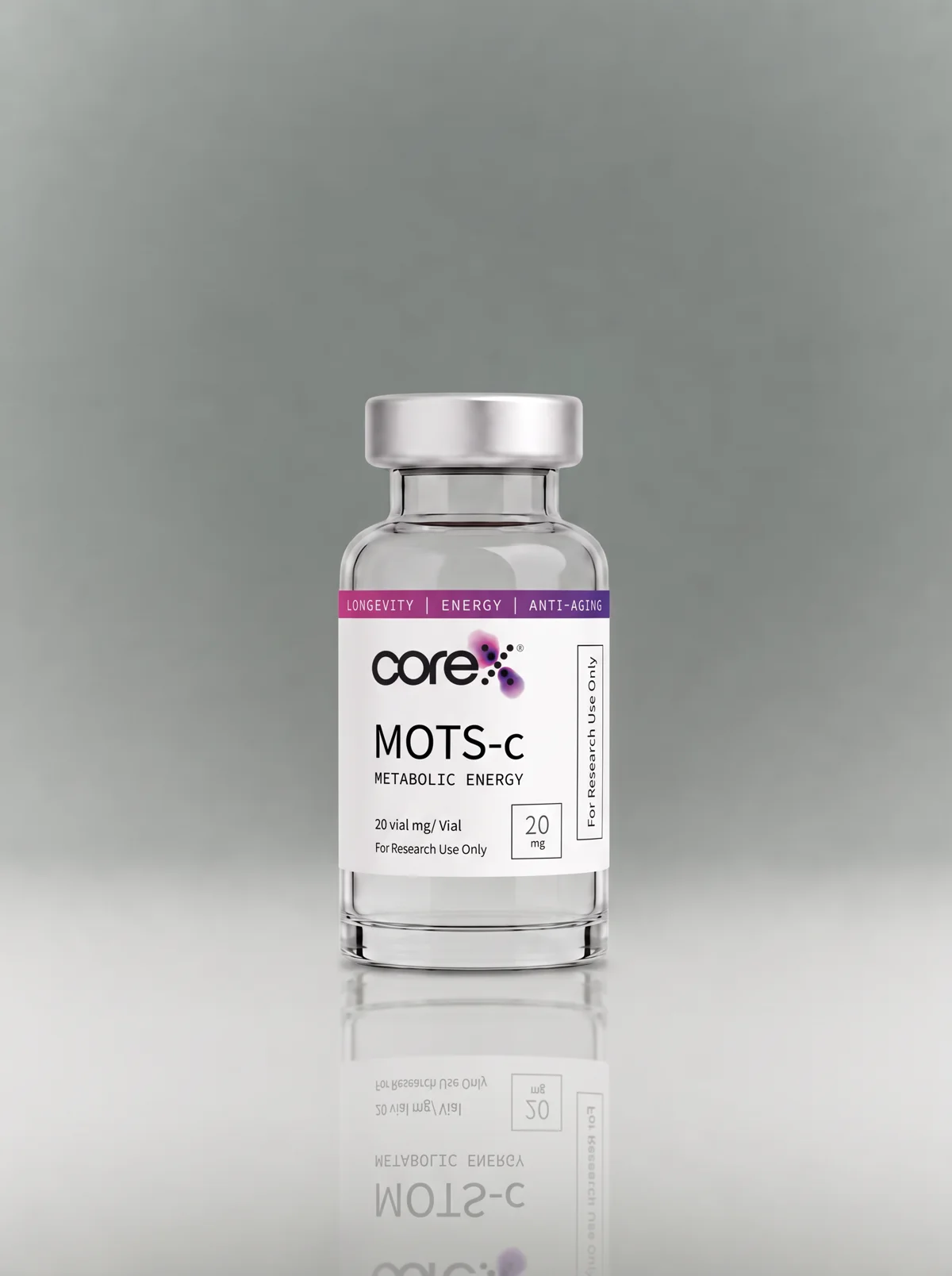
MOTS-c
Last reviewed September 26, 2026
MOTS-c is a peptide encoded in mitochondrial DNA. Research examines its role as a signal between the mitochondria and the nucleus, particularly under metabolic stress.
Mechanism of action
Research describes MOTS-c as translocating to the nucleus under metabolic stress, where it is studied for effects on genes governing metabolic homeostasis, largely via AMPK-associated pathways.
- Mitochondrial OriginEncoded within mitochondrial DNA and studied as a signal between the mitochondria and the rest of the cell.
- Metabolic ResponseExplored in research on AMPK-associated pathways governing how cells manage energy availability and stress.
- Route studied
- Subcutaneous
- Research status
- Preclinical
Published research on MOTS-c consists mainly of animal and cell studies along with review articles, and no late-stage clinical trials or regulatory approvals are described.
What the research covers
What research examines
- Metabolic homeostasis, obesity and insulin resistance in animal models
- Hyperglycemia and insulin resistance in gestational diabetes research
- Pancreatic islet cell senescence and diabetes onset
- Bone metabolism regulation
- Lung ischemia-reperfusion injury and antioxidant gene activation
- Ovarian cancer progression in laboratory studies
Reported effects in studies
- Human safety data are limited
- Adverse events are not summarized in the cited studies
- Long-term effects in humans have not been characterized
What research protocols have used
Research protocols have used 500–5,000 mcg per administration, 3 times per week (morning, fasted), in 8-week blocks with 4 weeks off.
For research use only. These figures summarize published research protocols. They are not instructions or medical advice.
Every CoreX order ships with a per-lot protocol guide.
Open the reconstitution calculatorResearched alongside
Cited research
- The mitochondrial-derived peptide MOTS-c promotes metabolic homeostasis and reduces obesity and insulin resistance.
Cell metabolism · 2015 · PubMed 25738459
- Mitochondria-derived peptide MOTS-c: effects and mechanisms related to stress, metabolism and aging.
Journal of translational medicine · 2023 · Review · PubMed 36670507
- The mitochondrial-derived peptide MOTS-c relieves hyperglycemia and insulin resistance in gestational diabetes mellitus.
Pharmacological research · 2022 · PubMed 34798268
- Mitochondrial-encoded peptide MOTS-c prevents pancreatic islet cell senescence to delay diabetes.
Experimental & molecular medicine · 2025 · PubMed 40855115
- MOTS-c attenuates lung ischemia-reperfusion injury via MYH9-Dependent nuclear translocation and transcriptional activation of antioxidant genes.
Redox biology · 2025 · PubMed 40403491
Questions about MOTS-c
MOTS-c is a peptide encoded within mitochondrial DNA rather than nuclear DNA. It is classed as a mitochondrial-derived peptide and is studied as a signaling molecule that carries information between the mitochondria and the rest of the cell. Research interest centers on its role under metabolic stress, where it has been examined for effects on how cells manage energy availability, and it is generally grouped with compounds studied in longevity and metabolic research.
Research describes MOTS-c as translocating to the nucleus when cells are under metabolic stress. Once there, it has been studied for effects on genes that govern metabolic homeostasis, largely through AMPK-associated pathways that help regulate cellular energy balance. One lung injury study reported nuclear translocation dependent on MYH9 and activation of antioxidant genes. These mechanisms come primarily from animal and cell research and have not been confirmed in human trials.
A frequently cited study reported that MOTS-c promoted metabolic homeostasis and reduced obesity and insulin resistance in experimental models. Other work has examined hyperglycemia and insulin resistance in gestational diabetes, pancreatic islet cell senescence and diabetes onset, bone metabolism, lung ischemia-reperfusion injury, sepsis-induced cardiomyopathy, and ovarian cancer progression. Several reviews also discuss its links to stress, metabolism and aging. This work is largely preclinical, and findings should not be taken as established human outcomes.
Human safety data for MOTS-c are limited. The available literature is dominated by animal studies, cell experiments and reviews, and adverse events are not summarized in the cited studies. Long-term effects, interactions and contraindications in humans have not been characterized. Because of these gaps, the safety profile of MOTS-c remains uncertain, and conclusions drawn from preclinical models may not reflect effects in people.
Research protocols have used 500 to 5,000 mcg per administration by the subcutaneous route, three times per week in the morning under fasted conditions. These protocols have been run in 8-week blocks followed by 4 weeks off. This information describes published research practice only and is not a recommendation. Each CoreX order ships with a protocol guide for laboratory reference.
Ask about MOTS-c
Our research assistant answers questions about the science, the studied ranges, and our products. It can be wrong, and it does not give medical advice.
MOTS-c at CoreX
Every batch is independently tested for identity and purity, and the certificate of analysis is tied to the lot number on your label.

Longevity
$99.00

Longevity
$109.00