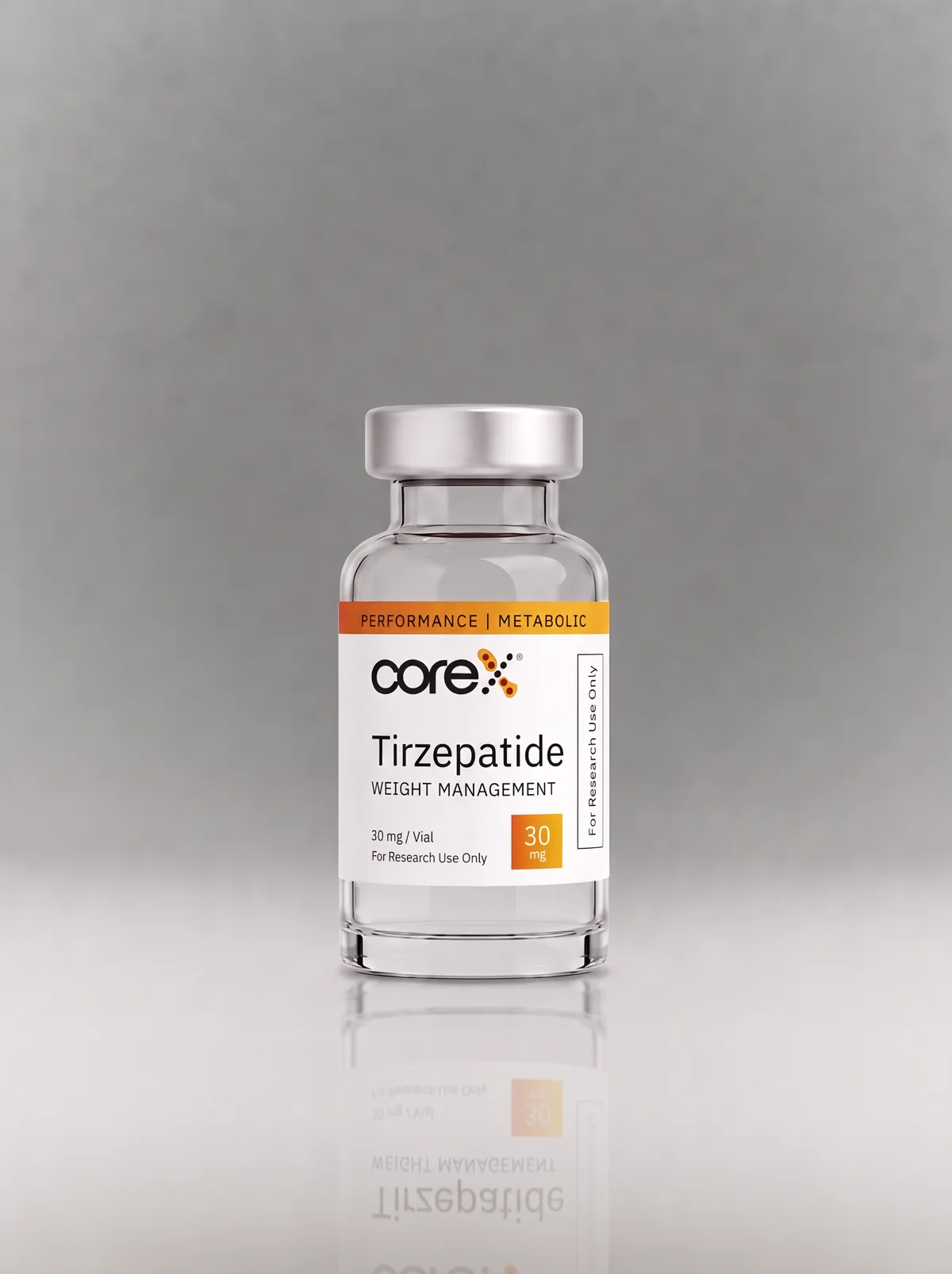
Tirzepatide
Last reviewed September 26, 2026
Tirzepatide is studied as a dual agonist at the GIP and GLP-1 receptors. Research examines whether combining the two incretin pathways differs from GLP-1 agonism alone.
Mechanism of action
Research investigates tirzepatide across both incretin receptors, studied for combined effects on insulin signaling, gastric emptying, and satiety.
- Dual IncretinStudied at both GIP and GLP-1 receptors, the GIP component distinguishing it from single agonists.
- Metabolic SignalingExplored for effects across glucose handling and appetite regulation together.
- Route studied
- Subcutaneous
- Receptor class
- GLP-1R / GIPR
- Research status
- Late clinical
Tirzepatide has been evaluated in multiple randomized phase 3 trials, including SURPASS-1, SURPASS-2 against semaglutide, and SURMOUNT-4, with phase 2 work in liver disease and a cardiovascular outcomes trial also underway.
What the research covers
What research examines
- Glycemic control in type 2 diabetes trials
- Weight reduction and weight maintenance in adults with obesity
- Appetite, energy intake, and fat mass
- Head-to-head comparison with semaglutide
- Metabolic dysfunction-associated steatohepatitis with liver fibrosis
- Cardiovascular outcomes compared with dulaglutide
Reported effects in studies
- Safety was a primary focus of phase 3 trials such as SURPASS-1, though specific adverse event rates are not summarized here
- Cardiovascular safety is being assessed against dulaglutide in the SURPASS-CVOT trial
- Studied for effects on gastric emptying as part of its mechanism
- Long-term safety outside controlled trial settings is not characterized in this overview
What research protocols have used
Research protocols have used 1.5–15 mg per administration, once weekly (morning, fasted), stepping up from 2.5 mg to 10 mg by week 13. Reported cycle: continuous until target weight loss.
For research use only. These figures summarize published research protocols. They are not instructions or medical advice.
Every CoreX order ships with a per-lot protocol guide.
Open the reconstitution calculatorResearched alongside
Cited research
- Efficacy and safety of a novel dual GIP and GLP-1 receptor agonist tirzepatide in patients with type 2 diabetes (SURPASS-1): a double-blind, randomised, phase 3 trial.
Lancet (London, England) · 2021 · RCT · PubMed 34186022
- Tirzepatide versus Semaglutide Once Weekly in Patients with Type 2 Diabetes.
The New England journal of medicine · 2021 · RCT · PubMed 34170647
- Continued Treatment With Tirzepatide for Maintenance of Weight Reduction in Adults With Obesity: The SURMOUNT-4 Randomized Clinical Trial.
JAMA · 2024 · RCT · PubMed 38078870
- Tirzepatide is an imbalanced and biased dual GIP and GLP-1 receptor agonist.
JCI insight · 2020 · PubMed 32730231
- Tirzepatide Reduces Appetite, Energy Intake, and Fat Mass in People With Type 2 Diabetes.
Diabetes care · 2023 · RCT · PubMed 36857477
Questions about Tirzepatide
Tirzepatide is a peptide studied as a dual agonist at the glucose-dependent insulinotropic polypeptide (GIP) and glucagon-like peptide-1 (GLP-1) receptors. Research examines whether engaging both incretin pathways produces effects that differ from GLP-1 agonism alone. It has been evaluated in large randomized clinical trials in type 2 diabetes and obesity, and in smaller trials exploring liver disease and cardiovascular outcomes.
Tirzepatide is studied at both the GIP and GLP-1 receptors, and its GIP activity distinguishes it from single-receptor GLP-1 agonists. Research has explored its combined effects on insulin signaling, gastric emptying, and satiety. Mechanistic work published in JCI Insight described it as an imbalanced and biased dual agonist, meaning its activity at the two receptors and their downstream signaling pathways is not equivalent.
Phase 3 trials have examined glycemic control in type 2 diabetes, including SURPASS-1 and a head-to-head comparison with semaglutide. The SURMOUNT-4 trial studied continued use for maintenance of weight reduction in adults with obesity, and a later trial compared it with semaglutide for obesity. Other studies have examined appetite, energy intake, and fat mass, liver fibrosis in steatohepatitis, and cardiovascular events versus dulaglutide.
Safety was assessed alongside efficacy in phase 3 trials such as SURPASS-1, and cardiovascular safety is being evaluated against dulaglutide in the SURPASS-CVOT trial. Specific adverse event types and rates are not summarized in this overview. Because the compound acts on gastric emptying as part of its studied mechanism, gastrointestinal effects are an area of research attention. Researchers should consult the primary trial publications for detailed safety findings.
Research protocols have used 1.5 to 15 mg per administration, given subcutaneously once weekly (morning, fasted), stepping up from 2.5 mg to 10 mg by week 13. The reported cycle was continuous until target weight loss. These figures describe what published protocols have used and are not recommendations. Each CoreX order ships with a protocol guide for laboratory reference.
Ask about Tirzepatide
Our research assistant answers questions about the science, the studied ranges, and our products. It can be wrong, and it does not give medical advice.
Tirzepatide at CoreX
Every batch is independently tested for identity and purity, and the certificate of analysis is tied to the lot number on your label.

Performance
$139.00