CJC-1295
Also known as Modified GRF 1-29, CJC-1295 no DAC, CJC-1295 without DAC
Last reviewed September 26, 2026
CJC-1295 without DAC, also called modified GRF 1-29, is a growth-hormone-releasing hormone analog with a short half-life, studied specifically for preserving the body's natural pulsatile release pattern.
Mechanism of action
Research describes it as a GHRH analog acting on pituitary receptors, with the absence of the drug affinity complex keeping its action brief rather than sustained.
- GHRH PathwayStudied as a releasing-hormone analog acting on the pituitary receptors that govern natural hormone pulses.
- Short Half-LifeWithout DAC its action is brief, which research associates with preserving the body's own pulsatile rhythm.
- Route studied
- Subcutaneous
- Receptor class
- GHRH-R
- Research status
- Early clinical
Published human data consist of small clinical studies, including a randomized controlled trial of the long-acting DAC form of CJC-1295 in healthy adults, while the no-DAC form (modified GRF 1-29) appears mainly in reviews and anti-doping detection research.
What the research covers
What research examines
- Growth hormone release through GHRH receptor signaling
- Preservation of natural pulsatile growth hormone release
- GH and IGF-I secretion in healthy adults (long-acting DAC form)
- Discussion in sports medicine and orthopaedic peptide reviews
- Discussion in healthy-aging peptide reviews
- Analytical detection of GHRH analogs in anti-doping testing
Reported effects in studies
- Human safety data specific to the no-DAC form are limited
- Adverse events are not summarized in the cited titles
- Reviews discuss safety questions around unapproved peptide therapies
- GHRH synthetic analogs are targeted by anti-doping detection methods and have been identified in seized doping material
What research protocols have used
Research protocols have used 100–300 mcg per administration, 5 days per week (pre-sleep), in 12-week blocks with 4 weeks off.
For research use only. These figures summarize published research protocols. They are not instructions or medical advice.
Every CoreX order ships with a per-lot protocol guide.
Open the reconstitution calculatorResearched alongside
Cited research
- Prolonged stimulation of growth hormone (GH) and insulin-like growth factor I secretion by CJC-1295, a long-acting analog of GH-releasing hormone, in healthy adults.
The Journal of clinical endocrinology and metabolism · 2006 · RCT · PubMed 16352683
- Advances in the detection of growth hormone releasing hormone synthetic analogs.
Drug testing and analysis · 2021 · PubMed 34665524
- Glycine-modified growth hormone secretagogues identified in seized doping material.
Drug testing and analysis · 2019 · PubMed 30136411
- Safety and Efficacy of Approved and Unapproved Peptide Therapies for Musculoskeletal Injuries and Athletic Performance.
Sports medicine (Auckland, N.Z.) · 2026 · Review · PubMed 41966639
- A new era of doping? Use of peptide and peptide-analog drugs in recreational and professional sport and bodybuilding: a critical review.
The Journal of sports medicine and physical fitness · 2026 · Review · PubMed 41880199
Questions about CJC-1295
CJC-1295 without DAC, also called modified GRF 1-29, is a synthetic analog of growth-hormone-releasing hormone (GHRH). It lacks the drug affinity complex (DAC) found in the long-acting version of CJC-1295, giving it a short half-life. Research interest centers on its potential to increase the amount of growth hormone released per pulse while preserving the body's natural pulsatile release pattern, rather than producing sustained elevation.
Research describes it as a GHRH analog that acts on GHRH receptors (GHRH-R) in the pituitary, the receptors that govern natural growth hormone pulses. Because it lacks the drug affinity complex, its action is brief rather than prolonged. Research associates this short duration with preserving the body's own pulsatile rhythm of growth hormone secretion, as opposed to the continuous stimulation reported with long-acting analogs.
The DAC version is a long-acting GHRH analog. A randomized controlled trial in healthy adults reported prolonged stimulation of growth hormone and insulin-like growth factor I secretion with that form. The no-DAC form, by contrast, has a short half-life and is studied for brief, pulse-level effects. Findings from the DAC trial should not be assumed to apply directly to the no-DAC form, since their durations of action differ substantially.
Human safety data specific to CJC-1295 without DAC are limited, and adverse events are not summarized in the cited titles. Recent reviews examine the safety and efficacy of approved and unapproved peptide therapies in musculoskeletal and athletic contexts. GHRH synthetic analogs are also a focus of anti-doping research, with validated detection methods published and glycine-modified secretagogues identified in seized doping material.
Research protocols have used 100–300 mcg per administration, 5 days per week (pre-sleep), in 12-week blocks with 4 weeks off, via the subcutaneous route. These figures describe research protocols only and are not recommendations. Each CoreX order ships with a protocol guide for laboratory reference. CoreX supplies CJC-1295 without DAC for laboratory research use only.
Ask about CJC-1295
Our research assistant answers questions about the science, the studied ranges, and our products. It can be wrong, and it does not give medical advice.
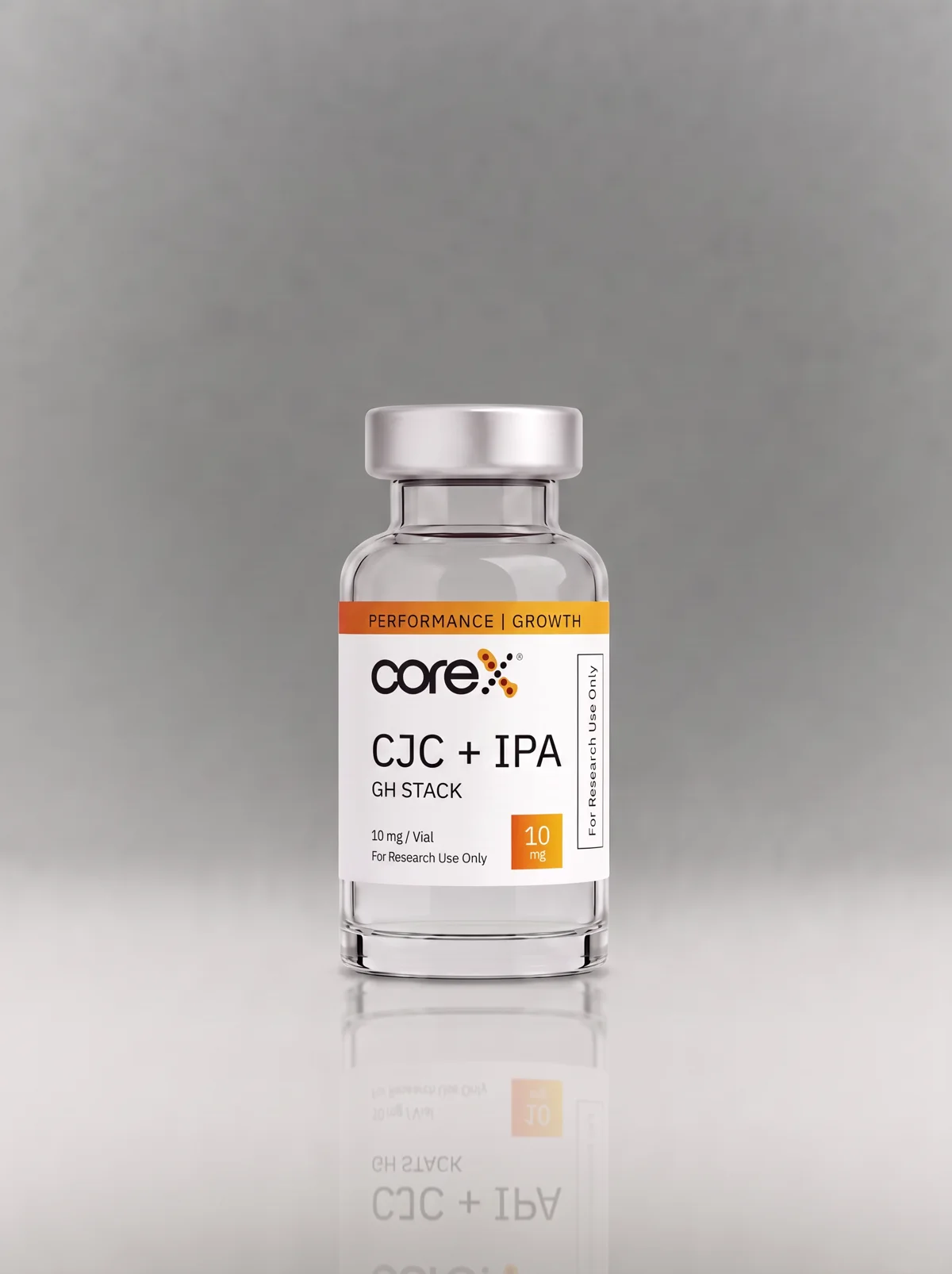
CJC-1295 at CoreX
Every batch is independently tested for identity and purity, and the certificate of analysis is tied to the lot number on your label.

Performance
$119.00