CJC-1295 vs Ipamorelin
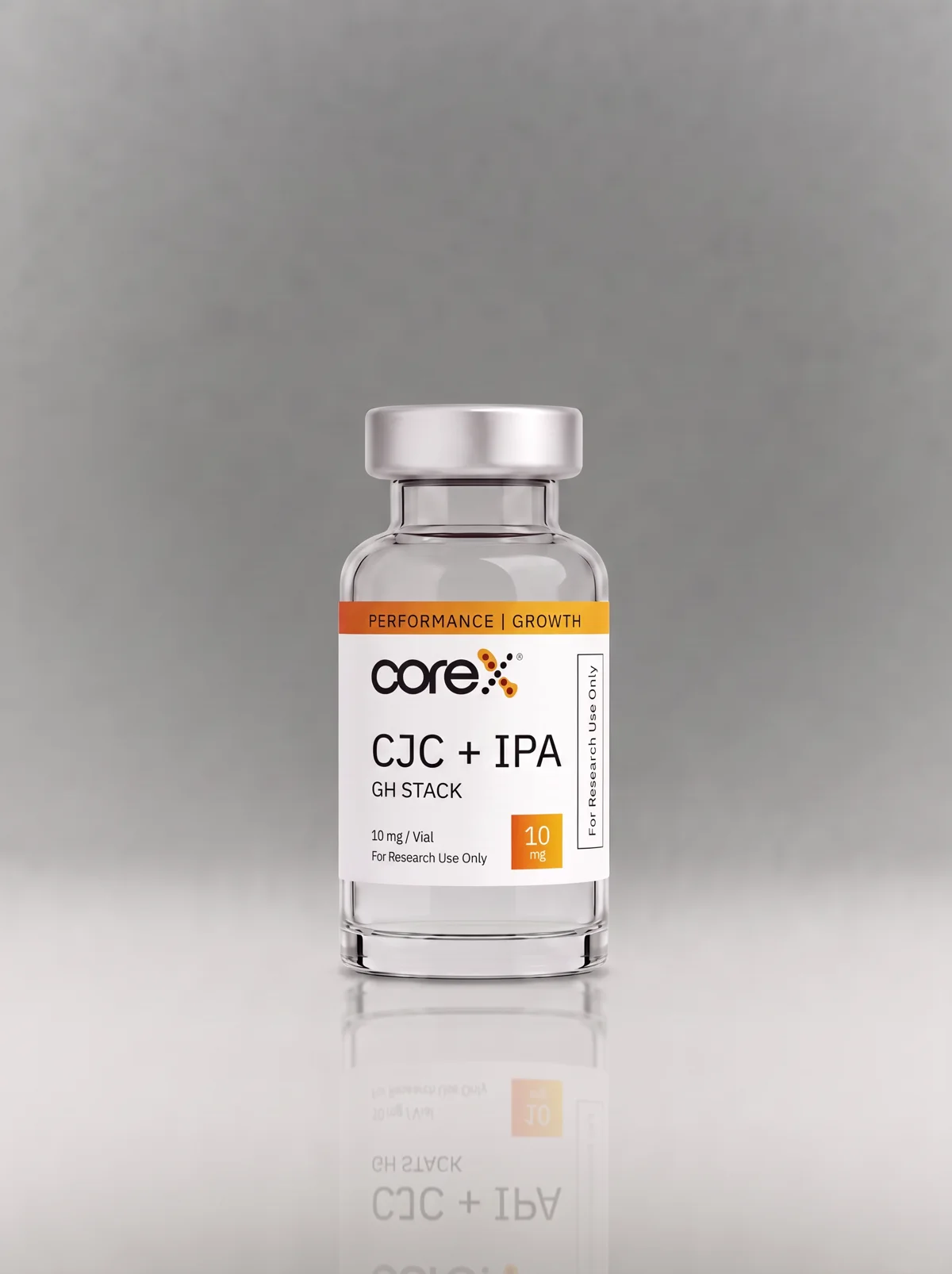
CJC-1295 and Ipamorelin are both peptides studied for their effects on growth hormone release, but they act through different receptor pathways. CJC-1295 without DAC, also called modified GRF 1-29, is a growth-hormone-releasing hormone (GHRH) analog with a short half-life. Research associates its brief action with preserving natural pulsatile release. Ipamorelin is a selective growth-hormone secretagogue that acts as a ghrelin receptor agonist, studied for releasing growth hormone with minimal cortisol or prolactin response. Published human data on CJC-1295 come mainly from small clinical studies of its long-acting DAC form. Ipamorelin's primary studies are animal work on growth hormone release and bone growth. Human safety data remain limited for both.
Key differences
- 01
CJC-1295 is described as acting on the GHRH receptor (GHRH-R), while Ipamorelin is described as acting on the ghrelin receptor (GHS-R1a).
- 02
CJC-1295 is studied as a releasing-hormone analog that raises the growth hormone released per pulse, whereas Ipamorelin is studied as a selective secretagogue producing a growth hormone pulse with minimal cortisol or prolactin response.
- 03
CJC-1295 is at an early-clinical stage, with small human studies mostly involving its long-acting DAC form, while Ipamorelin's evidence is largely preclinical, based mainly on rat studies.
- 04
Research on CJC-1295 without DAC centers on its short half-life and preservation of pulsatile release, while Ipamorelin research centers on receptor selectivity and has also examined longitudinal bone growth in rats.
- 05
Research protocols for CJC-1295 have used 12-week blocks with 4 weeks off, while protocols for Ipamorelin have used 8-week blocks with 4 weeks off.
Side by side
GHRH analog — raises GH released per pulse
Selective GHRP — clean GH pulse
Early clinical
Preclinical
Performance
Performance
Subcutaneous
Subcutaneous
Research protocols have used 100–300 mcg per administration, 5 days per week (pre-sleep), in 12-week blocks with 4 weeks off.
Research protocols have used 200–500 mcg per administration, 5 days per week (evening, fasted), in 8-week blocks with 4 weeks off.
- Growth hormone release through GHRH receptor signaling
- Preservation of natural pulsatile growth hormone release
- GH and IGF-I secretion in healthy adults (long-acting DAC form)
- Discussion in sports medicine and orthopaedic peptide reviews
- Discussion in healthy-aging peptide reviews
- Analytical detection of GHRH analogs in anti-doping testing
- Selective growth hormone release
- Minimal cortisol and prolactin response
- Longitudinal bone growth in rats
- Body composition in reviews of GH secretagogues
- Musculoskeletal and sports medicine peptide research
- Human safety data specific to the no-DAC form are limited
- Adverse events are not summarized in the cited titles
- Reviews discuss safety questions around unapproved peptide therapies
- GHRH synthetic analogs are targeted by anti-doping detection methods and have been identified in seized doping material
- Human safety data are limited
- Early research reported minimal effects on cortisol and prolactin
- Recent reviews assess it among unapproved peptide therapies
- Reviews discuss its use in sport and bodybuilding in a doping context
5 cited studies
5 cited studies
Studied ranges describe what published research protocols have used. They are not instructions or recommendations. Products are sold for research purposes only; each order ships with a protocol guide for the specific product.
Mechanism
CJC-1295
Research describes it as a GHRH analog acting on pituitary receptors, with the absence of the drug affinity complex keeping its action brief rather than sustained.
GHRH Pathway
Studied as a releasing-hormone analog acting on the pituitary receptors that govern natural hormone pulses.
Short Half-Life
Without DAC its action is brief, which research associates with preserving the body's own pulsatile rhythm.
Ipamorelin
Research describes ipamorelin as a ghrelin receptor agonist studied for stimulating growth hormone release without the broader hormonal activity of earlier secretagogues.
Receptor Selectivity
Studied for acting at the ghrelin receptor with minimal associated cortisol or prolactin response.
Pulsatile Release
Explored for producing a release pattern that resembles the body's own rhythm.