Glow (BPC-157 + TB-500 + GHK-Cu) vs KLOW (TB-500 + BPC-157 + GHK-Cu + KPV)
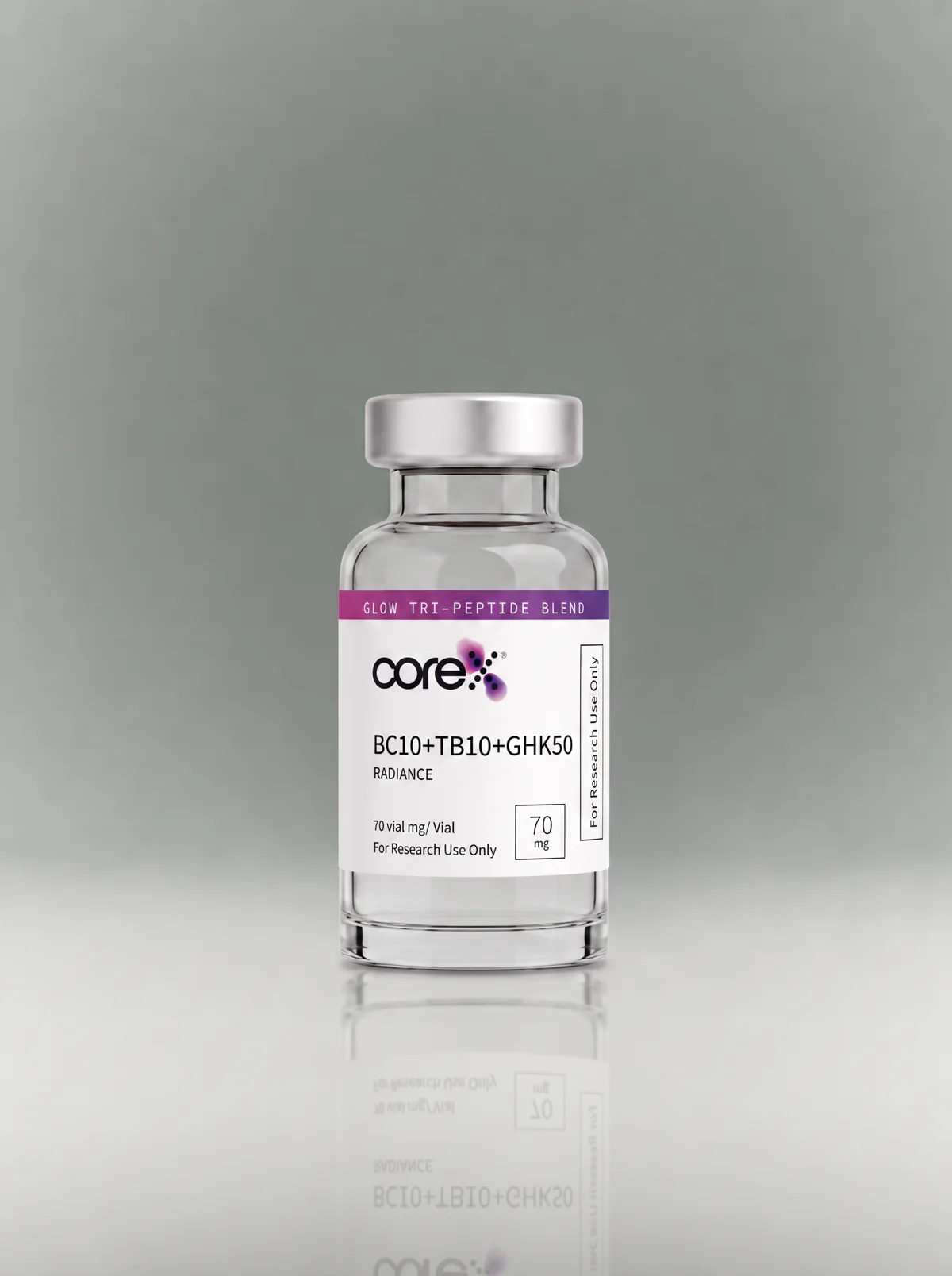
Glow and KLOW are multi-peptide research blends that share three components: BPC-157, TB-500, and GHK-Cu. Glow pairs two repair-associated peptides with GHK-Cu, the copper peptide most studied for skin and connective-tissue renewal. KLOW adds a fourth compound, KPV, which has been studied for inflammatory balance. The main mechanistic difference is therefore that KLOW layers an inflammatory-tone component onto the shared repair and remodeling profile of angiogenic and epithelial signaling, actin regulation, and copper-dependent collagen biology. Components of both blends have been studied for soft tissue healing in animal models, wound repair, and skin remodeling. Neither combination has been evaluated in published clinical trials, and human safety data for both are limited.
Key differences
- 01
KLOW includes KPV, a compound studied for inflammatory balance, while Glow does not include KPV and is limited to BPC-157, TB-500, and GHK-Cu.
- 02
Glow is described as a combined repair and collagen/skin-support blend, whereas KLOW is described as combining repair, collagen, and anti-inflammatory research focuses in one vial.
- 03
Research protocols for Glow have used 1.75–3.5 mg per administration, while protocols for KLOW have used 2–4 mg per administration.
- 04
Glow protocols have described a loading phase followed by a lower-frequency maintenance phase, whereas KLOW protocols are described as once daily in the morning under fasted conditions, with both using 8-week blocks and 4 weeks off.
Side by side
Combined repair + collagen/skin support
Repair, collagen, and anti-inflammatory in one vial
Preclinical
Preclinical
Longevity, Foundation
Foundation, Longevity
Subcutaneous
Subcutaneous
Research protocols have used 1.75–3.5 mg per administration, once daily (morning), with a loading phase before a lower-frequency maintenance phase, in 8-week blocks with 4 weeks off.
Research protocols have used 2–4 mg per administration, once daily (morning, fasted), in 8-week blocks with 4 weeks off.
- Soft tissue and musculoskeletal healing in animal models (BPC-157)
- Wound healing and epithelial repair (BPC-157)
- Actin regulation and tissue recovery signaling (TB-500)
- Copper-dependent collagen synthesis and skin remodeling (GHK-Cu)
- Gene expression and anti-aging research (GHK-Cu)
- Musculoskeletal soft tissue healing in animal models (BPC-157)
- Wound healing and epithelial repair (BPC-157)
- Skin and connective-tissue renewal (GHK-Cu)
- Gene expression linked to regenerative and protective actions (GHK-Cu)
- Cytoskeletal regulation in tissue repair (TB-500)
- Inflammatory balance (KPV)
- Human safety data for the combined blend are limited
- Adverse events are not summarized for the combination in published studies
- Reviews of BPC-157 have weighed its regenerative potential against unresolved safety questions
- Long-term safety of the individual component peptides in humans has not been established
- Human safety data for the combined blend are limited
- Adverse events for the four-compound combination have not been characterized in published studies
- Recent narrative review literature has raised open questions about the risk-benefit profile of BPC-157
- Human evidence for BPC-157 is limited to small reports, so safety conclusions remain preliminary
5 cited studies
5 cited studies
Studied ranges describe what published research protocols have used. They are not instructions or recommendations. Products are sold for research purposes only; each order ships with a protocol guide for the specific product.
Mechanism
Glow (BPC-157 + TB-500 + GHK-Cu)
The blend spans repair signaling and structural remodeling: angiogenic and epithelial pathways, actin regulation, and copper-dependent collagen biology.
Repair Plus Renewal
Combines compounds studied for tissue recovery with one studied specifically for dermal and structural protein synthesis.
Crossover Profile
Sits across Longevity and Foundation, reflecting the mixed repair and renewal focus of its components.
KLOW (TB-500 + BPC-157 + GHK-Cu + KPV)
Each component is studied for a different step, cytoskeletal regulation, angiogenic and epithelial signaling, copper-dependent remodeling, and inflammatory balance.
Layered Mechanisms
Four compounds studied for distinct but adjacent pathways across tissue repair, remodeling, and inflammatory tone.
Crossover Profile
The GHK-Cu component is studied for skin and connective-tissue renewal, which is why this sits across two families.