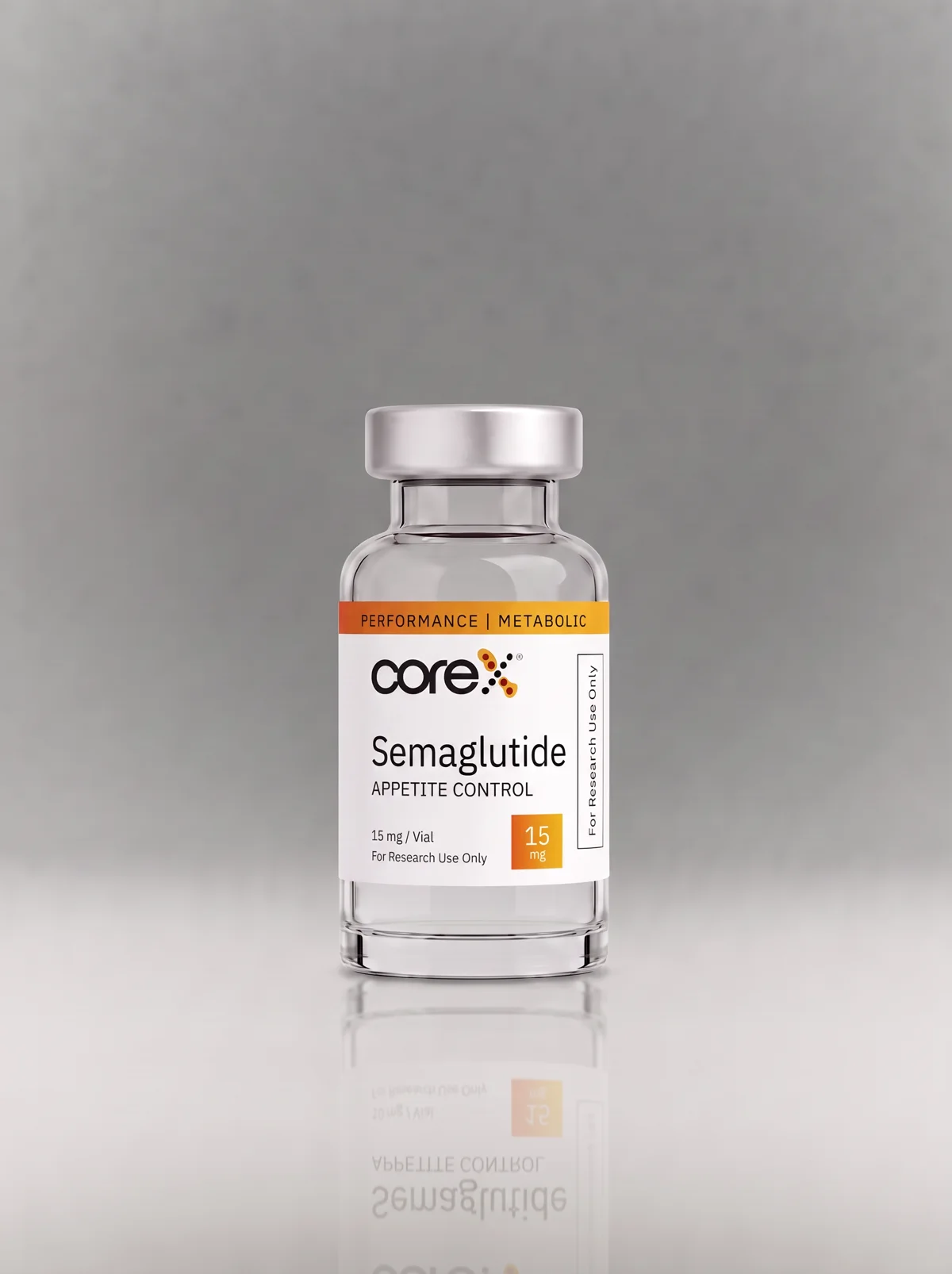
Semaglutide
Last reviewed September 26, 2026
Semaglutide is a long-acting GLP-1 receptor agonist. Research examines its role in glucose-dependent insulin signaling, gastric emptying, and the central pathways registering satiety.
Mechanism of action
Research describes semaglutide as an incretin mimetic with structural modifications that extend its half-life, studied for both peripheral glucose handling and central appetite signaling.
- Incretin PathwayStudied at the GLP-1 receptor for glucose-dependent insulin release rather than unconditional stimulation.
- Gastric EmptyingExplored for slowing the rate at which the stomach empties, associated with prolonged fullness.
- Route studied
- Subcutaneous
- Receptor class
- GLP-1R
- Research status
- Approved analog
Semaglutide has been evaluated in randomized controlled trials and meta-analyses, and a semaglutide product, Wegovy, has been described in the literature as a weight loss drug for chronic weight management.
What the research covers
What research examines
- Weight loss in obesity without diabetes
- Glucose-dependent insulin signaling via the GLP-1 receptor
- Gastric emptying and satiety signaling
- Distributed neural pathways of body weight regulation in rodents
- Heart failure with preserved ejection fraction in observational research
- Clinical pharmacokinetics and extended half-life
Reported effects in studies
- Risk of nonarteritic anterior ischemic optic neuropathy has been examined in patients prescribed semaglutide
- Effects on lean mass have been reviewed across clinical trials
- Slowed gastric emptying is a studied mechanism of action
- Overall safety has been the subject of a dedicated published review
What research protocols have used
Research protocols have used 250–2,000 mcg per administration, once weekly (morning, fasted), stepping up from 250 mcg to 2 mg by week 13. Reported cycle: continuous until target weight loss.
For research use only. These figures summarize published research protocols. They are not instructions or medical advice.
Every CoreX order ships with a per-lot protocol guide.
Open the reconstitution calculatorCited research
- Efficacy and Safety of Semaglutide for Weight Loss in Obesity Without Diabetes: A Systematic Review and Meta-Analysis.
Journal of the ASEAN Federation of Endocrine Societies · 2022 · Meta-analysis · PubMed 36578889
- Long-term weight loss effects of semaglutide in obesity without diabetes in the SELECT trial.
Nature medicine · 2024 · RCT · PubMed 38740993
- Semaglutide lowers body weight in rodents via distributed neural pathways.
JCI insight · 2020 · PubMed 32213703
- Safety of Semaglutide.
Frontiers in endocrinology · 2021 · Review · PubMed 34305810
- Risk of Nonarteritic Anterior Ischemic Optic Neuropathy in Patients Prescribed Semaglutide.
JAMA ophthalmology · 2024 · PubMed 38958939
Questions about Semaglutide
Semaglutide is a long-acting GLP-1 receptor agonist. It is described in research as an incretin mimetic carrying structural modifications that extend its half-life. Research examines its role in glucose-dependent insulin signaling, gastric emptying, and the central pathways that register satiety. Published reviews trace its discovery and development alongside liraglutide, an earlier compound in the same class, and a semaglutide product has been described as a weight loss drug for chronic weight management.
Semaglutide acts at the GLP-1 receptor. Research describes its effect on insulin release as glucose-dependent rather than unconditional stimulation. It has also been explored for slowing the rate at which the stomach empties, which is associated with prolonged fullness. Rodent work reports that semaglutide lowers body weight through distributed neural pathways, supporting the view that it acts on both peripheral glucose handling and central appetite signaling.
Research has studied semaglutide for weight loss in people with obesity without diabetes, including a systematic review and meta-analysis and long-term analyses from the SELECT randomized controlled trial. Other work has examined its clinical pharmacokinetics, its effect on lean mass, the neural pathways involved in body weight reduction in rodents, and outcomes in heart failure with preserved ejection fraction in an observational comparison with tirzepatide.
Safety of semaglutide has been summarized in a dedicated published review. A study in JAMA Ophthalmology examined the risk of nonarteritic anterior ischemic optic neuropathy in patients prescribed semaglutide, and a systematic review assessed its effect on lean mass during clinical trials. Slowed gastric emptying is part of its studied mechanism. Detailed adverse event rates are not summarized here, and the primary literature should be consulted for specifics.
Research protocols have used 250 to 2,000 mcg per administration, given once weekly in the morning in a fasted state, stepping up from 250 mcg to 2 mg by week 13. The reported cycle is continuous until target weight loss, with a subcutaneous route described. This information reflects research protocols only and is not a recommendation. Each CoreX order ships with a protocol guide for laboratory reference.
Ask about Semaglutide
Our research assistant answers questions about the science, the studied ranges, and our products. It can be wrong, and it does not give medical advice.
Semaglutide at CoreX
Every batch is independently tested for identity and purity, and the certificate of analysis is tied to the lot number on your label.

Performance
$69.00